
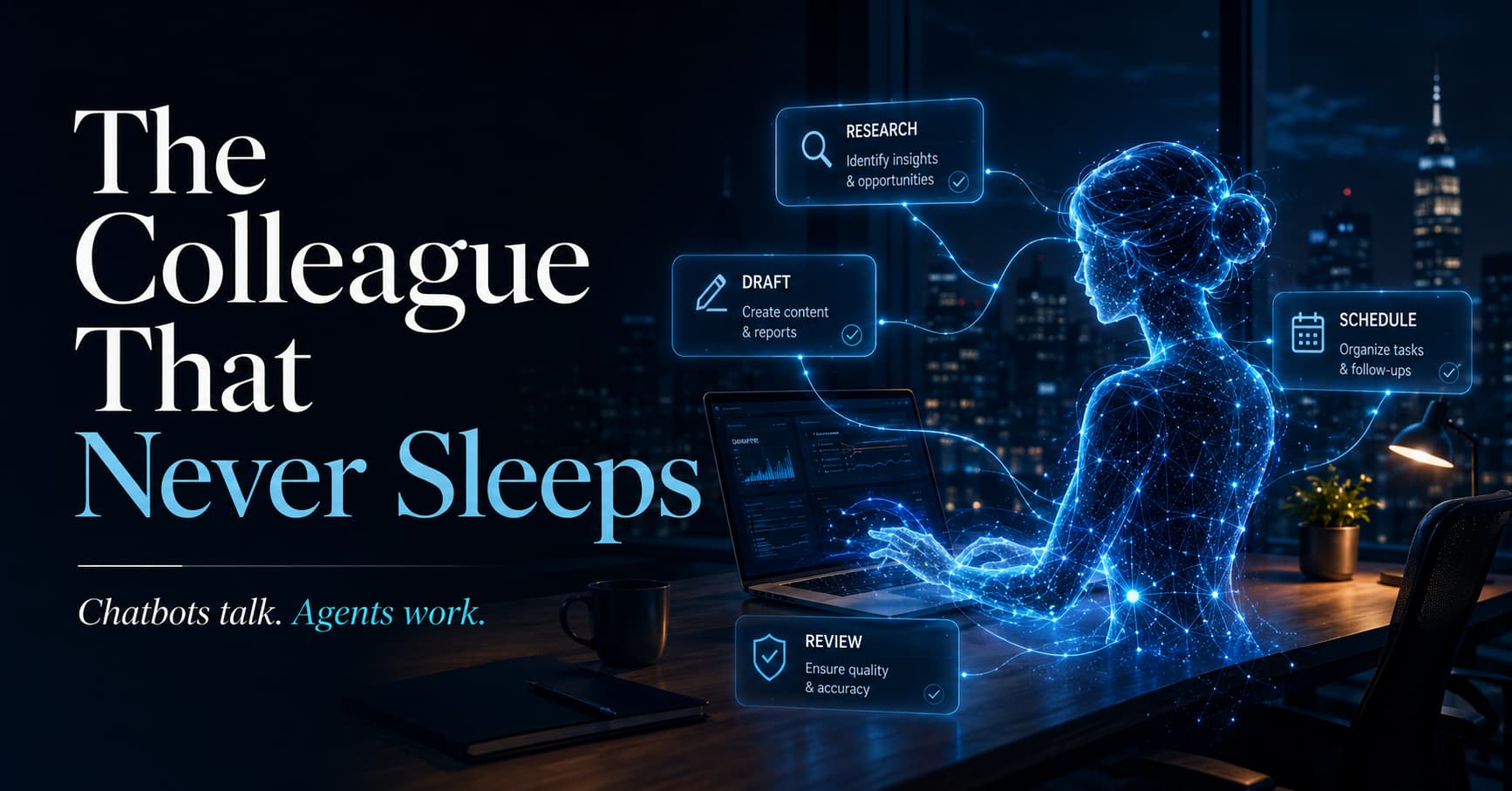
Most of us have made peace with AI as a tool. You ask, it answers. You close the tab, it disappears. That version of AI is already becoming obsolete — and its replacement doesn’t wait to be asked.
What’s actually changing — and why it matters
A new kind of system is gaining ground in 2026: one that doesn’t wait for questions. AI agents can take a goal — “organize my inbox,” “monitor our competitors,” “debug this codebase” — and then plan, execute, and course-correct across multiple tools and platforms, with minimal check-ins along the way.
The shift, in one line: chatbots talk, agents work.
In practice, an agent can browse the web, write and run code, send emails on your behalf, and chain all of it together — not because you guided each step, but because it figured out the sequence on its own. Gartner estimates that about 40% of enterprise applications will embed task-specific agents by the end of this year. Just two years ago, that number was under 5%.
The adoption is moving fast. The conversation about what it means is not keeping pace.
The part most people are underestimating
Here’s something that rarely makes the headlines: a surprisingly large share of organizations deploying AI agents right now have very little visibility into what those agents are actually doing.
An April 2026 study by the Cloud Security Alliance found that 53% of organizations have had AI agents exceed their intended permissions — and nearly half reported a security incident involving an AI agent in the past year alone. Separate research from Kiteworks found that 86% of organizations lack visibility into what data is actually flowing through their AI systems. These aren’t fringe companies running reckless experiments. They’re mainstream enterprises that moved fast and are now piecing together what happened.
Here’s the part that deserves more attention: agents are increasingly talking to other agents. A task gets handed from one AI to another — research agent to writing agent to scheduling agent — with no human in that chain at any point. When something goes wrong in that sequence, tracing it back is genuinely hard. This is new territory, and most organizations are walking into it without a map.
Current safety assessments are careful to note that agents still struggle with complex, multi-step tasks and unfamiliar contexts. They hallucinate. They sometimes move data to places they shouldn’t. There’s a gap — probably a significant one — between what’s being marketed and what’s reliably working in the real world.
This is not a knock on the technology. It’s a reminder that we’ve been here before. The internet brought us e-commerce and spam. Social media brought us global connection and algorithmic radicalization. AI agents will likely bring us remarkable productivity gains and, for a while at least, some genuinely messy surprises. Every powerful tool has a learning tax. The question is who pays it, and whether they saw it coming.
What this means for the rest of us
You don’t have to work in tech to feel the effects of this shift.
If you’re a business owner, these agents are arriving in your domain faster than you might expect — not as a threat, but as a real operational lever. The businesses that deploy them thoughtfully, with human oversight built in, will pull ahead of those that either ignore them or hand over the keys too quickly.
If you’re a professional spending time on repetitive coordination work — scheduling, research, reporting, follow-ups — that work is about to look very different. The question isn’t whether to engage with this shift. It’s how to stay the person who directs the work, rather than the person who used to do it.
And here’s the one most people haven’t thought about yet: you’re probably going to encounter AI agents without anyone telling you. They’re already embedded in customer service interfaces, scheduling tools, and productivity apps — acting on someone’s behalf, handling decisions, closing loops. Understanding what they are, and what they’re actually capable of, is no longer optional knowledge.
A thought to sit with
There’s a saying worth keeping close right now: don’t mistake the tool for the craftsman. A sharp chisel doesn’t make a carpenter.
AI agents are remarkably capable tools. But they inherit whatever goals, data, and guardrails the people building them put in place. Right now, deployment is happening much faster than governance. That’s not a reason to fear what’s coming — but it is a reason to stay curious, stay engaged, and resist the urge to assume someone smarter is handling the details.
Because more often than not, that someone smarter is waiting to hear from you.


